
Stop Chasing Keywords: If Keywords are Dead, How Does Google Find Me?
Understanding the 2026 Digital Marketing Trends begins with a simple realization: the old way of “tricking” a search engine is over. For two decades, we treated Google like a librarian matching words on a page. Today, that librarian has evolved into a decision engine. At Optzio, we are moving from literal text-matching to a model of deep understanding. If your current strategy is still anchored to word counts and ranking positions, you are essentially invisible to the modern web.
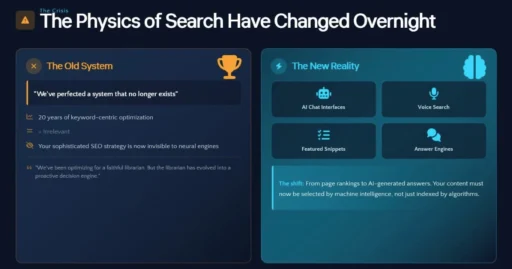
The landscape of Search Engine Optimization has fundamentally changed its governing physics and Knowledge Graph. For too long, we have operated under the assumption that search is a deterministic retrieval system—a faithful librarian matching queries to text strings. This mental model, centered entirely on the keyword, has reached a critical inflection point, rendering many sophisticated SEO strategies invisible overnight. Search engines have evolved from passive librarians into proactive, probabilistic decision engines that prioritize understanding over optimization.
At Optzio, we redefine Search Engine Optimization by moving from literal matching to semantic understanding and Entity Authority in Semantic Search. If your growth strategy is still anchored primarily to keyword volume and ranking positions, you are optimizing for a system that no longer dictates authority. While keywords haven’t vanished, their role has been functionally demoted. True, sustainable visibility is now governed by the integrity of your Neural Footprint—how consistently and deeply your expertise is mapped across the living knowledge graph.
Why Neural Nodes Define the Top 2026 Digital Marketing Trends
The shift from keywords to “Neural Nodes” is not just a technical change; it is a change in how we communicate. A Neural Node is a unit of meaning. Instead of isolated pages, search engines now see the web as a living map of entities and relationships. If your brand isn’t mapped as a trusted authority, your traffic will decay—even if your old SEO checklist looks perfect. This is the new reality of digital visibility.
For nearly two decades, digital marketing relied on a predictable, four-step formula: Identify keywords, optimize pages, build links, and track rankings. This model was highly effective because the underlying search infrastructure was literal; it rewarded the precise, predictable matching of text strings to user input. Success was a matter of execution efficiency within a known, finite set of rules.
The failure of this mental model stems from its inability to adapt to the contextual nature of neural search systems. Modern search is no longer literal; it is highly probabilistic, adaptive, and deeply contextual, integrating real-time user behavior and evolving semantic relationships. The inquiry has shifted entirely: Search engines no longer ask, “Does this page contain the keyword?” They now ask, “Does this entity demonstrate comprehensive domain mastery regarding the underlying problem the user is trying to solve?”
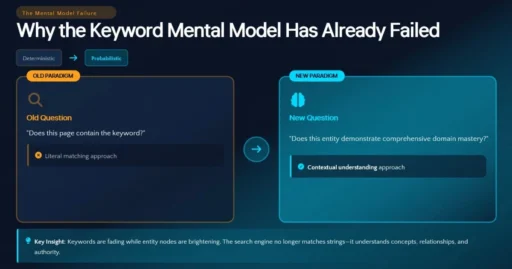
Moving from Simple Rankings to Machine-Led Decisions
In the era of 2026 Digital Marketing Trends, search engines no longer ask, “Does this page have the word?” They ask, “Does this person actually solve the user’s problem?” We call this the shift from Retrieval to Understanding. To survive, you must stop being a content publisher and start being a trusted reference.
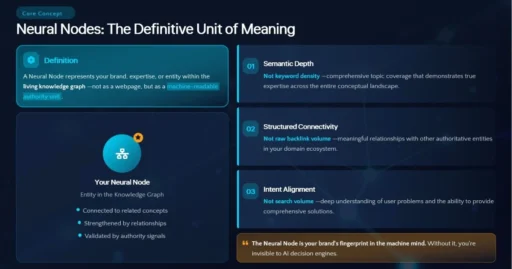
Constructing a Neural Node is the first step toward advanced Search Engine Optimization.. A Neural Node is the definitive unit of meaning in the modern search environment, representing a concept, entity, or expertise within the expansive knowledge graph. Instead of viewing content as a collection of isolated pages, we must recognize that modern machine intelligence treats every brand, product, service, and expert as an interconnected node, constantly being assessed for relevance, intent alignment, and trust signals.
The architecture of a robust Neural Node moves far beyond traditional textual analysis. A node is successfully built not from density, but from three core elements:
Concepts: The underlying semantic depth, not just surface phrases.
Relationships: The structured connectivity between ideas, superseding raw backlink volume.
Context: The alignment of content with user intent and the broader domain of knowledge.
How to Architect Visibility: The Four Layers of Modern Search
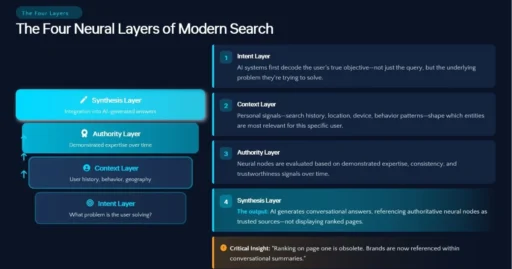
Traditional SEO cannot reach the layers where AI makes decisions. To align with current 2026 Digital Marketing Trends, we architect your presence across four simultaneous layers:
The Intent Layer: Deciphering what the human actually needs.
The Context Layer: Integrating history and behavior to shape the answer.
The Authority Layer: Proving your expertise over time (E-E-A-T).
The Synthesis Layer: Making your knowledge easy for AI to summarize and cite.
Traditional Search Engine Optimization cannot penetrate the synthesis layer of modern AI. Modern search visibility is not a singular metric; it is the culmination of successful navigation across four simultaneous neural layers that govern the decision engine’s output. Our architecture at Optzio LLM Optimization aligns with all four to guarantee a comprehensive presence in AI-generated answers and summaries.
1.The Intent and Context Layers
The process begins by deciphering the true problem the user is attempting to solve. The Intent Layer moves past literal phrasing, while the Context Layer integrates external signals—user behavior, history, and geographic data—to shape the required answer. Visibility is initially filtered based on the entity’s ability to demonstrate deep understanding, not just their keyword count.
2.The Authority and Synthesis Layers
The final two layers determine trustworthiness. The Authority Layer assesses which entities have consistently demonstrated expertise over time. Finally, the Synthesis Layer evaluates which source best integrates diverse, authoritative perspectives into a single, cohesive, and easily extractable answer.
From Ranking Pages to Being the Primary Reference
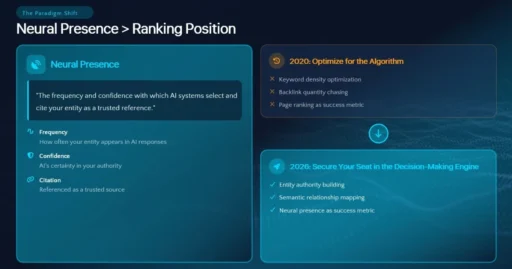
By 2026, “ranking on page one” is an obsolete goal. Modern brands are no longer ranked; they are referenced inside conversational summaries and AI answers. Your goal is Neural Presence—how often AI systems select you as the expert source. This transition requires us to unify your digital assets into one cohesive footprint that machines can read and humans can trust.
In 2026, the notion of ranking on E-E-A-T Framework and pages sequentially is becoming obsolete; brands are no longer ranked—they are referenced. Search engine output increasingly manifests as conversational summaries, brand mentions within AI-generated answers, and entity-based recommendations. Securing a “Position 1” link is now a short-sighted strategy.
Our strategic goal must shift to securing Neural Presence. This is defined as the frequency and confidence with which a brand entity is selected and cited by autonomous AI systems as a trusted reference point. This transition mandates that we move beyond fragmented tactics and unify disparate assets into one cohesive neural footprint.
The Evolutionary Bridge: Navigating SEO in 2026
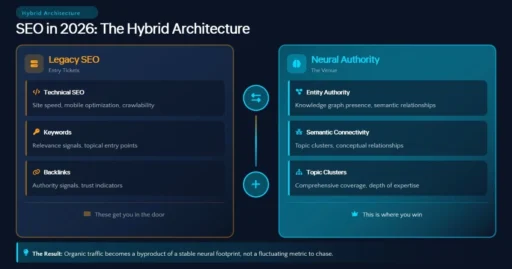
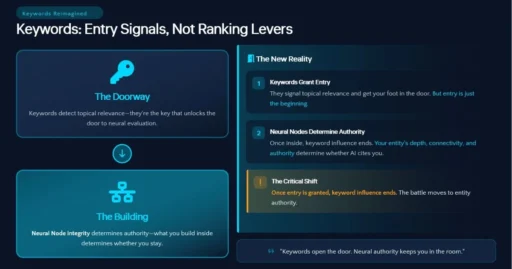
We don’t ignore the past; we evolve it. Mastery of 2026 Digital Marketing Trends requires a hybrid approach. We treat legacy elements like technical site speed and keyword signals as the “doorway” to get you noticed, but we use Neural Nodes to keep you “in the room.” We view organic traffic as a byproduct of your brand’s technical and emotional integrity.
Mastering Search Engine Optimization in 2026 requires a hybrid approach between legacy signals and neural nodes. At Optzio Neural Lab, we don’t discard the foundations of Search Engine Optimization (SEO); we evolve them. To achieve total digital visibility, one must understand how legacy Technical SEO and Keyword Research function as the entry signals for the knowledge graph.
Traditional On-Page SEO and Content Optimization were once the primary levers for a Page One Ranking. However, in a neural-first environment, these elements now serve a different purpose. They are no longer about “tricking” an algorithm; they are about providing the structural clarity needed for a Google Ranking in conversational and generative search.
While the industry once obsessed over raw Backlinks, we now prioritize Semantic Connectivity. We view Organic Traffic not as a fluctuating metric, but as a byproduct of a stable neural footprint. By aligning your Search Engine Optimization strategy with our 2026 framework, you aren’t just chasing a Page One Ranking—you are securing a permanent seat in the decision-making engine of the web.
Neural Semantic Pack:
“To maintain E-E-A-T (Experience, Expertise, Authoritativeness, Trustworthiness), our lab integrates Semantic Analysis with a robust Knowledge Graph strategy. By focusing on the Search Generative Experience (SGE), we ensure that Entity-Based SEO is not just a tactic, but a fundamental layer of your digital visibility infrastructure.”
Your 5-Step Neural Action Plan
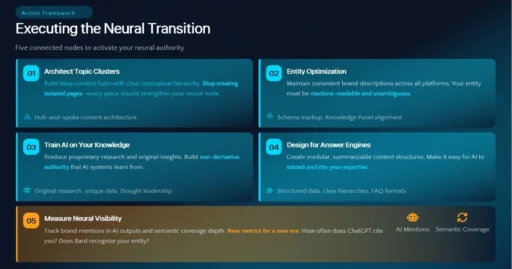
To dominate the upcoming 2026 Digital Marketing Trends, you must execute these steps:
Build Topic Hubs: Stop writing isolated posts; build deep centers of knowledge.
Optimize for Identity: Ensure your brand is recognized as a verifiable entity.
Use Proprietary Knowledge: Train your AI on your own unique insights, not generic data.
Structure for Answers: Design content to be modular and easily cited by AI.
Audit Your Visibility: Measure how often AI mentions your brand, not just your clicks.
Conclusion: The Human Soul in a Machine Economy
The end of keyword dependency is the beginning of brand sovereignty. As search systems move toward understanding, the brands that invest in their neural structure today will own the attention of tomorrow. Optzio is not just an agency; we are the bridge between your human strategy and the machine’s intelligence
Brands that invest in neural structure today will own attention tomorrow. Those that do not will find their authority diluted, competing on shrinking margins as search systems simply stop noticing them.
Optzio Neural Lab is not an agency. It is a transition layer between human strategy and machine intelligence.
Run Your AI Audit with Optzio
If you want to know how search engines and AI systems currently perceive your brand, there is only one starting point.
Run an AI Audit on Optzio.com.
Discover your neural gaps.
Activate your future visibility.
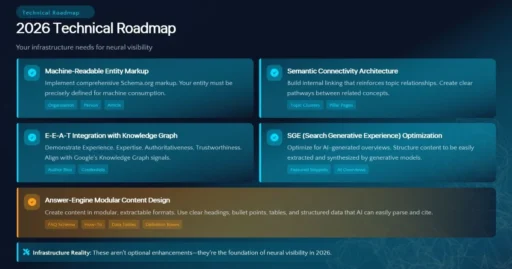
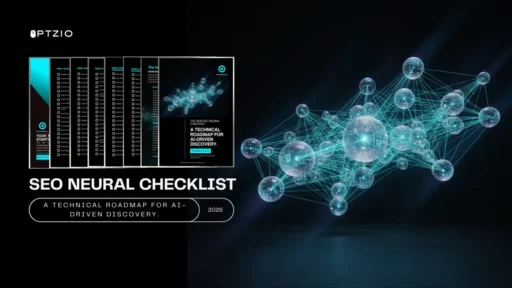
The 2026 SEO Neural Checklist: Technical Roadmap for AI Search Dominance
Neural Lab Technical Appendix
To ensure total Digital Visibility, this Search Engine Optimization framework leverages Artificial Intelligence and Machine Learning to align with User Intent. By focusing on Semantic Search and Topical Authority, we move beyond legacy Page Rankings. Our Content Strategy is designed for the Search Generative Experience (SGE), ensuring that every Information Node is indexed within the global Knowledge Graph.
By prioritizing Algorithm transparency and Link Building through semantic relevance, we ensure that Keyword Ranking is replaced by total Entity Authority across all Search Results.