


Scale Without Selling Your Soul: Can AI Actually Sound Like a Human Expert?
In the current digital landscape, the biggest risk to your brand is not moving too slowly—it is moving without a soul. As we scale, the demand for human-sounding AI content has reached a critical tipping point. Most businesses use machines to write, but very few use them to think.
At Optzio Neural Lab, we believe that content is no longer just a collection of words on a page; it is a technical artifact engineered to be felt. If your audience can tell a robot wrote your message, you haven’t just failed a technical test—you have lost the “Neural Handshake” of trust. To survive 2026, you must learn the art of perfecting your voice.
Artificial intelligence is transforming digital publishing. Content that once required days of writing can now be generated in seconds.
However, automation alone does not guarantee success.
Search platforms such as Google Search and AI-driven assistants like Gemini are increasingly capable of identifying valuable information versus repetitive material.
They analyze signals such as expertise, clarity, and originality. If an article simply repeats information already available online, it offers little value to readers or search engines.
Human readers behave the same way. When content feels generic or automated, people quickly move on.
This is why businesses must focus on human-sounding AI content that communicates knowledge clearly and naturally.
What Is Human-sounding AI Content?
Human-sounding AI content is AI-generated writing that preserves natural tone, real expertise, and authentic human perspective. It combines artificial intelligence efficiency with human experience to create content that feels trustworthy, helpful, and conversational.
Businesses use human-sounding AI content to scale publishing while maintaining credibility with readers and search engines.
Key characteristics include:
Natural sentence variation
Clear explanations
Real insights and examples
Consistent brand voice
THE MANIFESTO (Slide 1)
The ‘AI Smell’: Why Robotic Text is a Silent Brand Killer Human-sounding AI contentin
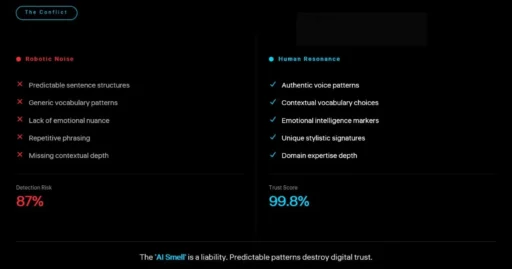
This phenomenon is backed by recent linguistic research on AI detection patterns, which proves that ‘Burstiness’ is the missing element in most automated content. we see it every day. A brand publishes 100 articles in a week, yet their traffic remains flat. Why? Because search engines and humans have developed a shared sense for the “AI Smell.” This “smell” is found in predictable sentence patterns, extremely safe conclusions, and the total absence of a unique perspective.
Generic human-sounding AI content does not exist in a vacuum. When a machine produces text without human grit, it creates “Semantic Noise.” This noise is invisible to the Knowledge Graph because it offers nothing new. To rank in a world of answer engines like Gemini and Search GPT, your content must provide non-derivative authority. If you are just echoing the internet, the internet will eventually stop listeniBeyond the Prompt: Injecting the Architect’s Grit
Most people believe the “Prompt” is the final step. At the Lab, we know the prompt is just the beginning—it is the brush, not the painting. To achieve true human-sounding AI content, we must move into what we call “Architectural Ingestion.”
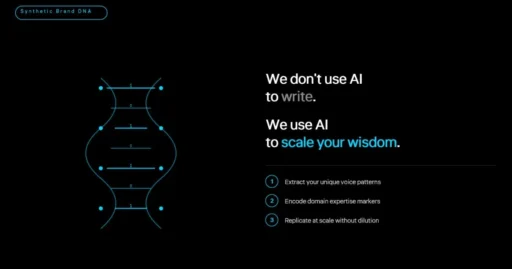
This means teaching the machine your unique story, your failures, and your specific technical opinions. We call this “Learning your story.” By feeding the AI your proprietary internal frameworks, you move from “Generative AI” (which guesses) to “Synthetic Synthesis” (which replicates your wisdom). This is how a machine begins to sound like a human expert: it stops reciting data and starts presenting a point of view.
Readers today are becoming better at identifying automated writing. Even when grammar is perfect, something may feel unnatural.
This effect is sometimes called the “AI smell.”
Common signals include:
repetitive sentence patterns
identical paragraph lengths
overly formal or generic wording
conclusions that offer little insight
Human writing is more varied. People mix short sentences with longer explanations. They sometimes ask questions or highlight surprising ideas.
When these natural elements are missing, content begins to feel mechanical.
Creating human-sounding AI content requires adding these human qualities back into the writing process.
THE CONFLICT (Slide 2)
The 3-Step Optzio Protocol for Human-sounding AI Content
To help our students and clients scale for humanity, we have simplified our internal engine logic into three clear phases. This is the same logic that powers our NHS-2.0 Terminal.
1. Perspective Mapping
Before you write a single word, you must map your unique stance. What do you believe that the rest of your industry is getting wrong? This “Contradictory Signal” is the first thing we inject into the machine to break the robotic loop.
2. Cadence Calibration
Humans breathe; machines don’t. This translates into writing rhythm. Machines write in “even” blocks. Humans write with “Burstiness”—short, punchy sentences followed by deep, explanatory ones. Our protocol forces the engine to adopt this “Seamless Voice.”
3. Ethical Synthesis
The final step is the human handshake. We audit the output for radical transparency. Does this sound honest? Does it offer real-world value? If the answer is no, we re-sync the DNA.
SYNTHETIC BRAND DNA (Slide 4)
E-E-A-T in 2026: Why Google Ranks Wisdom, not Just Data
While Google’s official guidelines on helpful content have always prioritized the user, the ability for machines to detect the difference between a bot and an expert has reached a new level of precision. Google’s core mission has not changed, but its ability to detect “fakes” has evolved. In 2026, E-E-A-T (Experience, Expertise, Authoritativeness, Trustworthiness) is the only currency that matters. Search engines are no longer librarians matching keywords; they are Decision Engines looking for a trusted reference.
When you produce human-sounding AI content that is anchored in real-world experience, you become a “Fixed Node” in the Knowledge Graph. This means that even as algorithms change, your visibility compounds. You are no longer chasing the trend; you are the source that the trend is built upon.
The Sovereign Affiliate Engine: Turning Authority into Revenue
For those in our community looking to build passive digital infrastructure, the rules have changed. You cannot build a successful business by dumping generic affiliate links into robotic reviews.
We have designed The Sovereign Affiliate Engine (Digital PDF Guide) specifically to solve this. It teaches you how to use our human-sounding AI content logic to build “Trust-First” affiliate nodes. Instead of selling a product, you are architecting a solution. When the user trusts the Architect, the commission is a natural byproduct of the value provided.
THE REVENUE REVOLUTION (Slide 8/Affiliate Slide 1)

Key Takeaways
Human-sounding AI content combines AI speed with real human expertise.
Generic AI writing often fails because it lacks unique perspectives.
Search engines evaluate content using experience, expertise, authority, and trust.
Businesses should guide AI with real insights rather than relying on automated prompts alone.
High-quality AI-assisted writing can strengthen brand credibility and search visibility.
Frequently Asked Questions
What is human-sounding AI content?
Human-sounding AI content is writing produced with AI tools but refined with human insights, tone, and experience. The goal is to ensure the content reads naturally and provides real value to readers.
Why does AI content sometimes sound robotic?
AI-generated text can sound robotic because it follows predictable language patterns and lacks real-world experience or unique opinions.
Can human-sounding AI content rank in search engines?
Yes. High-quality human-sounding AI content can perform very well in search engines because it combines useful information with natural readability.
How can businesses improve AI-generated writing?
Businesses should provide AI systems with clear perspectives, real examples, and expert knowledge. Editing and human review are also essential for improving quality.
Conclusion: Technology for the Betterment of Everyone
The transition to a neural economy is not about replacing humans; it is about amplifying the best of us. At Optzio Neural Lab 2.0, we provide these terminals and guides for free because we believe high-end intelligence should be a human right.
Artificial intelligence will continue transforming the digital world. Content production will become faster and more efficient in the coming years.
Yet the most successful brands will not be those that publish the most articles.
They will be the ones that communicate clearly, share real knowledge, and maintain authentic voices.
By focusing on human-sounding AI content, businesses can scale their publishing efforts while preserving trust with their audience.
Technology should support human expertise, not replace it.
Organizations that combine AI efficiency with genuine insight will build stronger relationships with readers and achieve lasting digital visibility.