


The End of Guesswork: Can I Really See My ROI Before I Spend $1? (Predictive Marketing ROI)

Predictive Marketing ROI is changing how modern businesses make advertising decisions. For years, marketing leaders relied on instinct, past experience, and trial-and-error campaigns to determine whether an advertisement would succeed. Sometimes the results were positive, but many campaigns wasted budget because the outcome was unknown until after the money was spent.
Today, Predictive Marketing ROI allows businesses to evaluate potential performance before launching a campaign. Instead of guessing which message, audience, or platform will work best, machine learning systems analyze behavioral patterns and calculate probabilities.
At Optzio Neural Lab, this approach helps companies move away from uncertainty and toward intelligent marketing decisions. When organizations can estimate the potential return before spending even one dollar, marketing becomes a strategic investment rather than a risky experiment.
The Cost of Maybe: Why Traditional Advertising Is a Leak (Predictive Marketing ROI)
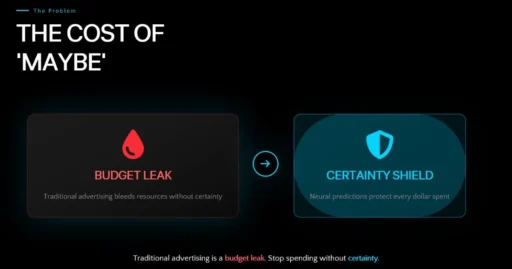
Traditional advertising often works like a slow leak in a company’s budget.
Businesses launch campaigns across multiple platforms, wait weeks for results, and only afterward discover which ads worked and which ones failed. During that time, thousands of dollars may have been spent on audiences who were never likely to engage.
Without predictive insights, marketing teams must rely on assumptions. Even experienced marketers cannot analyze millions of behavioral signals manually. This is why traditional campaigns often produce inconsistent results.
When companies implement Predictive Marketing ROI, this problem begins to disappear. Instead of waiting for results after a campaign runs, organizations gain visibility into the probability of success before the campaign begins.
Predictive Marketing ROI: Moving from Luck to Logic
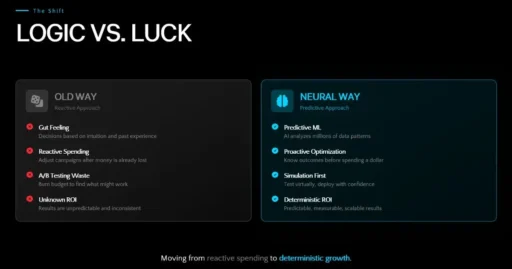
Predictive Marketing ROI represents a fundamental shift in how marketing decisions are made.
Instead of launching campaigns and analyzing results afterward, organizations can now evaluate potential outcomes before spending money.
This transformation is made possible through machine learning systems that recognize patterns across large datasets. These systems study historical behavior—clicks, purchases, browsing patterns, engagement signals—and identify relationships between actions and results.
At its core, Predictive Marketing ROI answers a simple question:
What is the probability that this marketing action will generate a measurable return?
Rather than relying on assumptions, the system evaluates thousands of variables simultaneously.
Examples include:
audience behavior patterns
timing of engagement
historical campaign performance
platform-specific interaction trends
In Predictive Analytics By analyzing these signals, predictive systems estimate which strategies are most likely to succeed.
The outcome is not a guarantee. Marketing will always involve uncertainty. But the level of uncertainty becomes dramatically smaller.
Instead of launching campaigns blindly, businesses gain a probability-based view of success.
For decision-makers, this changes everything. Budget planning becomes more strategic. Campaign design becomes more precise. Risk becomes measurable.
This is the essence of Predictive Marketing ROI: replacing luck with logic.
https://optzio.gumroad.com/l/neural-seo-checklist
How Our Prediction Engine Learns from Behavioral Data (Predictive Marketing ROI)
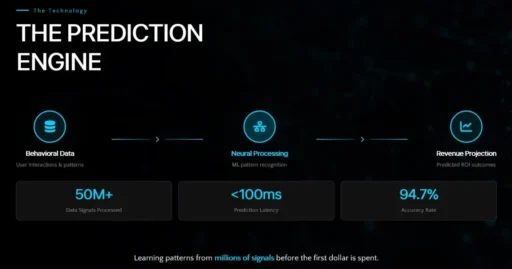
Many predictive systems are described using technical language that can feel overwhelming. In reality, the concept is easier to understand.
Think of it as a Prediction Engine that learns patterns from human behavior.
Every digital interaction leaves a trace. A click on an advertisement. A pause while reading a page. A purchase after comparing products. These signals form behavioral data—small pieces of information that reveal how people move through the digital world.
The Prediction Engine studies these signals over time.
Instead of simply recording activity, it searches for patterns. Which audience segments respond to certain messages? Which times of day generate the highest engagement? Which combinations of creative content and placement lead to conversions?
This process is not static. The engine continuously improves its understanding by learning from new data.
We describe this process as learning the patterns.
The system begins with historical information, identifies relationships between actions and outcomes, and then tests those relationships against new data. As more signals appear, the predictions become increasingly accurate.
This is how Predictive Marketing ROI becomes possible.
Rather than guessing which campaign will succeed, the Prediction Engine evaluates past behavior and calculates probabilities based on real evidence.
Behavioral data becomes the teacher. Machine learning becomes the interpreter. Businesses receive insights that guide their decisions.
The 2026 Blueprint for Ad Spend Efficiency (Predictive Marketing ROI)

As marketing enters the next decade, efficiency will become the defining advantage. Organizations that can predict outcomes before investing will allocate resources more effectively than those relying on traditional experimentation.
Predictive Marketing ROI forms the foundation of this new blueprint.
Instead of distributing budgets evenly across multiple channels, predictive systems identify the placements with the highest probability of success. Campaigns become more focused. Messages become more targeted. Waste decreases.
Ad spend efficiency emerges through several mechanisms.
First, predictive models identify high-value audience segments before a campaign launches. This prevents budgets from being diluted across audiences unlikely to convert.
Second, the system analyzes behavioral timing. It recognizes when engagement is most likely to occur and schedules campaigns accordingly.
Third, predictive insights guide creative strategy. Messaging that historically performs well with specific audiences receives priority.
When these elements combine, the result is a marketing ecosystem designed for precision rather than guesswork.
This approach is supported by ongoing research in data science and behavioral analytics. Studies from institutions such as Harvard Business Review and MIT continue to demonstrate how predictive modeling improves marketing efficiency.
(Placeholder for DoFollow link to authoritative study.)
Predictive Marketing ROI does not eliminate human creativity. Instead, it gives creative ideas a clearer path toward measurable results.
Predicting the First Click Before It Happens
One of the most powerful capabilities of predictive systems is anticipating the first interaction between a user and a campaign.
Before a user even sees an advertisement, the Prediction Engine evaluates the probability that the person will engage with it.
This calculation considers numerous signals:
browsing history patterns
engagement behavior with similar content
device usage habits
timing of online activity
From these signals, the system estimates the likelihood of a click.
If the probability is low, the campaign can be adjusted before launch. If the probability is high, the campaign receives priority placement.
In simple terms, marketers can now predict the first click before it happens.
This ability dramatically improves Ad Spend Efficiency. Instead of discovering ineffective campaigns after launch, businesses refine them before money is spent.
The Role of Data Sovereignty in Predictive Marketing

As predictive systems become more influential, another concept becomes equally important: data sovereignty.
Data sovereignty refers to the principle that organizations should control how their data is collected, stored, and used.
Predictive Marketing ROI relies heavily on behavioral insights. When companies manage their own data responsibly, they gain more reliable signals while maintaining ethical standards.
Transparent data practices build trust with users and ensure predictive systems operate within clear boundaries.
In the future, organizations that treat data responsibly will have stronger predictive capabilities and stronger relationships with their audiences.
Conclusion: From Guesswork to Intelligent Decisions
Marketing will always involve creativity and experimentation. But it no longer needs to rely on uncertainty.
Predictive Marketing ROI provides businesses with a powerful advantage: the ability to evaluate potential outcomes before investing resources.
By learning from behavioral patterns, predictive systems reveal which strategies are most likely to succeed. Marketing decisions become more informed, campaigns become more efficient, and budgets are used more strategically.
For leaders responsible for growth, this shift represents a new level of clarity.
The question is no longer “What might happen if we run this campaign?”
The question becomes: “What does the data suggest will happen—and how can we optimize it?”
Visibility Audit
Before launching your next campaign, consider these questions:
Audience Clarity
Do you understand which behavioral signals define your ideal customer?
Campaign Probability
Have you evaluated the likelihood of engagement before allocating budget?
Data Control
Is your organization managing its behavioral data responsibly and strategically?
Ad Spend Efficiency
Are your campaigns guided by predictive insights or historical guesswork?
If these questions reveal gaps, the solution is simple.
Frequently Asked Questions About Predictive Marketing ROI
What is Predictive Marketing ROI?
Predictive Marketing ROI is a method that helps businesses estimate the potential return from a marketing campaign before they spend money on it. Instead of launching ads and waiting for results, predictive systems analyze past behavioral patterns to calculate the probability of success.
This approach helps companies make smarter decisions and reduce wasted advertising budgets.
How does Predictive Marketing ROI work?
Predictive Marketing ROI works by analyzing behavioral data, such as clicks, browsing habits, purchases, and engagement patterns. Machine learning systems study these signals to understand how people respond to different marketing messages.
Once the system recognizes patterns, it can estimate how likely a new campaign is to perform well.
This allows marketers to adjust their strategy before spending money.
Why is Predictive Marketing ROI important for modern businesses?
Marketing budgets are often limited, and traditional advertising involves a lot of uncertainty. Predictive Marketing ROI helps businesses reduce that uncertainty.
By understanding which campaigns are most likely to succeed, companies can focus their budget on strategies that deliver real results instead of relying on guesswork.
Can Predictive Marketing ROI improve ad spend efficiency?
Yes. One of the biggest advantages of Predictive Marketing ROI is improved Ad Spend Efficiency.
Predictive systems identify audiences that are more likely to engage with your ads. This means your marketing budget is directed toward people who already show interest in your product or service.
The result is less wasted spending and better campaign performance.
What role does behavioral data play in Predictive Marketing ROI?
Behavioral data is the foundation of Predictive Marketing ROI.
Every online interaction—such as clicks, searches, page views, or purchases—creates signals about how people behave online. Predictive systems analyze these signals to identify patterns and predict future actions.
The more accurate the behavioral data, the stronger the predictions become.
Is Predictive Marketing ROI only for large companies?
No. While large companies were early adopters, Predictive Marketing ROI is now accessible to businesses of all sizes.
Modern marketing platforms and AI tools allow small and medium-sized companies to analyze behavioral patterns and make data-driven decisions without massive budgets.
This makes predictive marketing a powerful tool for growing businesses.
How can businesses start using Predictive Marketing ROI?
The first step is collecting and organizing behavioral data from your marketing channels. This may include website analytics, advertising performance, and audience engagement metrics.
From there, predictive tools analyze these signals and begin identifying patterns that can guide future campaigns.
Organizations like Optzio Neural Lab help businesses build these systems and turn marketing insights into measurable outcomes.
Can Predictive Marketing ROI really predict the first click?
Predictive systems cannot guarantee every result, but they can estimate the probability of engagement, including the likelihood of a user clicking on an advertisement.
By analyzing past behavioral patterns, the system can determine which audiences are most likely to interact with a campaign. This allows marketers to adjust their strategy before launching ads.
Run Your ROI Simulation
At Optzio Neural Lab, we help organizations move from uncertainty to intelligent marketing systems.
Instead of launching campaigns blindly, you can simulate outcomes, test scenarios, and evaluate probability before spending your first dollar.
Run Your ROI Simulation and discover how predictive intelligence can transform the way your business approaches growth.