
AI Workflow Orchestration The Autonomous Agency: Building Self-Optimizing Marketing Workflows with AI Agents
Marketing agencies are not failing because of talent gaps.
They are failing because humans are still acting as the operating system.
In 2026, the competitive advantage is no longer strategy, tools, or even data. It is orchestration. Brands that still rely on manual handoffs, linear approvals, and human-dependent optimization loops are structurally incapable of competing with autonomous systems.
The future agency does not execute tasks.
It designs intelligence.
Why the Traditional Agency Model Has Reached Its Limit
Modern marketing operations are overloaded with friction:
Strategy decks disconnected from execution
Specialists working in silos
Delayed feedback loops
Optimization based on outdated data
Even AI-powered tools are often bolted onto broken workflows. Automation without orchestration simply accelerates chaos.
At Optzio Neural Lab, we see a clear truth:
Efficiency gains are capped unless workflows themselves become intelligent.
What AI Workflow Orchestration Actually Means
AI Workflow Orchestration is not task automation.
It is decision automation across interconnected systems.
At Optzio, we define it as:
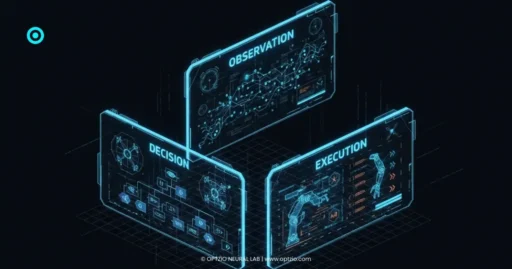
“A system where AI agents observe, decide, execute, and optimize marketing actions continuously—without human micromanagement.”
This shifts marketing from project management to neural coordination.
From Tools to Agents
Most organizations deploy AI as tools.
AI for writing
AI for analytics
AI for bidding
AI for reporting
These tools operate independently.
Agents operate collaboratively.
AI Agents differ because they:
Possess defined roles and objectives
Monitor specific signals
Take autonomous actions
Learn from outcomes
Optzio does not deploy AI assistants.
We architect agent ecosystems.
The Anatomy of an Autonomous Marketing Agency
An autonomous agency is a system, not a team.
Core Components
Strategic Intent Layer
Human-defined goals, constraints, and ethics.Agent Network Layer
Specialized AI agents with narrow accountability.Feedback and Learning Layer
Continuous performance evaluation and model refinement.Execution Layer
Platforms, channels, and APIs where actions occur.
Humans no longer push buttons.
They design the rules of intelligence.
Why Manual Optimization Is a Bottleneck
Optimization today is episodic.
Weekly reports
Monthly reviews
Quarterly strategy resets
Markets do not move in quarters.
AI-driven systems operate in minutes.
Optzio replaces delayed optimization with continuous self-correction.
Optzio’s AI Agent Architecture
Optzio builds orchestration frameworks where agents operate with precision and accountability.
1. Observation Agents
These agents monitor:
Audience behavior shifts
Platform algorithm changes
Conversion anomalies
Creative fatigue signals
They do not report data.
They trigger decisions.
2. Decision Agents
Decision agents evaluate scenarios using predefined objectives.
They determine:
Budget reallocation
Creative rotation
Channel prioritization
Bidding adjustments
Every action is probabilistic, not reactive.
3. Execution Agents
Execution agents interface directly with platforms.
They:
Launch and pause campaigns
Adjust bids and targeting
Deploy creative variations
Enforce compliance rules
Speed is measured in seconds, not days.
4. Learning Agents
Learning agents close the loop.
They:
Compare predicted vs actual outcomes
Identify signal decay
Retrain models continuously
This is how workflows become self-optimizing.
Why Orchestration Beats Automation
Automation executes instructions.
Orchestration decides what instruction should exist.
Without orchestration:
Tools conflict with each other
Optimization decisions contradict strategy
Humans become bottlenecks again
Optzio ensures all agents operate under a single Strategic Intent Graph.
Bridging Manual Marketing and Neural Automation
Most brands are stuck in transition.
They have:
Human-led strategy
Tool-driven execution
Fragmented accountability
Optzio bridges this gap by encoding strategy into machines.
The Optzio Approach
Humans define direction
AI agents manage execution
Systems optimize continuously
This is not removing humans.
It is liberating them from operational drag.
Use Cases of the Autonomous Agency
Paid Media Orchestration
Agents manage:
Cross-platform budget allocation
Creative fatigue detection
Predictive ROI optimization
Human intervention becomes optional.
Content Distribution Systems
Agents decide:
What content to deploy
Where to deploy it
When to refresh narratives
Content becomes adaptive, not scheduled.
Lead Qualification and Routing
Agents evaluate:
Intent strength
Conversion probability
Sales-readiness signals
Leads are routed with predictive precision.
Why This Is a Structural Advantage
Autonomous systems compound intelligence.
Every decision improves the next
Every failure becomes a training signal
Every success increases confidence
Manual systems plateau.
Autonomous systems accelerate.
The Risk of Not Adopting Orchestration
Organizations that delay orchestration will face:
Rising acquisition costs
Slower reaction times
Talent burnout
Strategic blind spots
By the time results decline, recovery will be expensive.
Optzio’s clients are not preparing for the future.
They are operating inside it.

The Neural Action Plan
Step 1: Map Strategic Intent
Define objectives, constraints, and ethical boundaries.
AI without intent becomes misaligned.
Step 2: Decompose Workflows into Decisions
Identify where humans decide repeatedly.
These are orchestration opportunities.
Step 3: Assign Agent Accountability
Each agent must own a single outcome.
Blurred roles destroy autonomy.
Step 4: Build Continuous Feedback Loops
Ensure agents learn from every action.
Static systems decay.
Step 5: Elevate Humans to Architects
Remove humans from execution.
Position them as designers of intelligence.
The Agency of the Future Is Not a Company
It is a system of systems.
Clients will no longer hire agencies for manpower.
They will hire decision architectures.
Optzio is building that architecture.
Why This Changes the Definition of Marketing
Marketing becomes:
Adaptive
Predictive
Self-correcting
Campaigns dissolve into continuous intelligence flows.
The brand is no longer managed.
It is orchestrated.
Optzio’s Role in the Autonomous Era
Optzio does not deploy isolated AI tools.
We engineer neural operating systems for growth.
Our mission is to help brands:
Transition from execution to orchestration
Replace manual workflows with autonomous intelligence
Scale without increasing complexity
This is the Autonomous Agency model.
Final Thought
The question is no longer “How efficient is your team?”
The question is “How autonomous is your system?”
The future belongs to organizations that design intelligence, not workflows.
If you want to understand how close your marketing operations are to autonomy,
run an AI Audit on Optzio.com.
The era of manual optimization is ending.
The era of self-optimizing intelligence has already begun.